BiCAT

Bimanual Coordination Action Tokenization

National University of Singapore

† Corresponding author

+17.6pts
Mean success over the strongest of eight tokenizers on ten RoboTwin 2.0 tasks (69.3% vs 51.7%)
113/150
Real-world trials succeeded on six tasks, versus 74 for OAT and 25 for FAST
40.5ms
Per action chunk with only two decoding steps (H200, token generation)
2.7×
Lower real-robot inference latency than OAT on YAM (91.7 ms vs 251.6 ms)
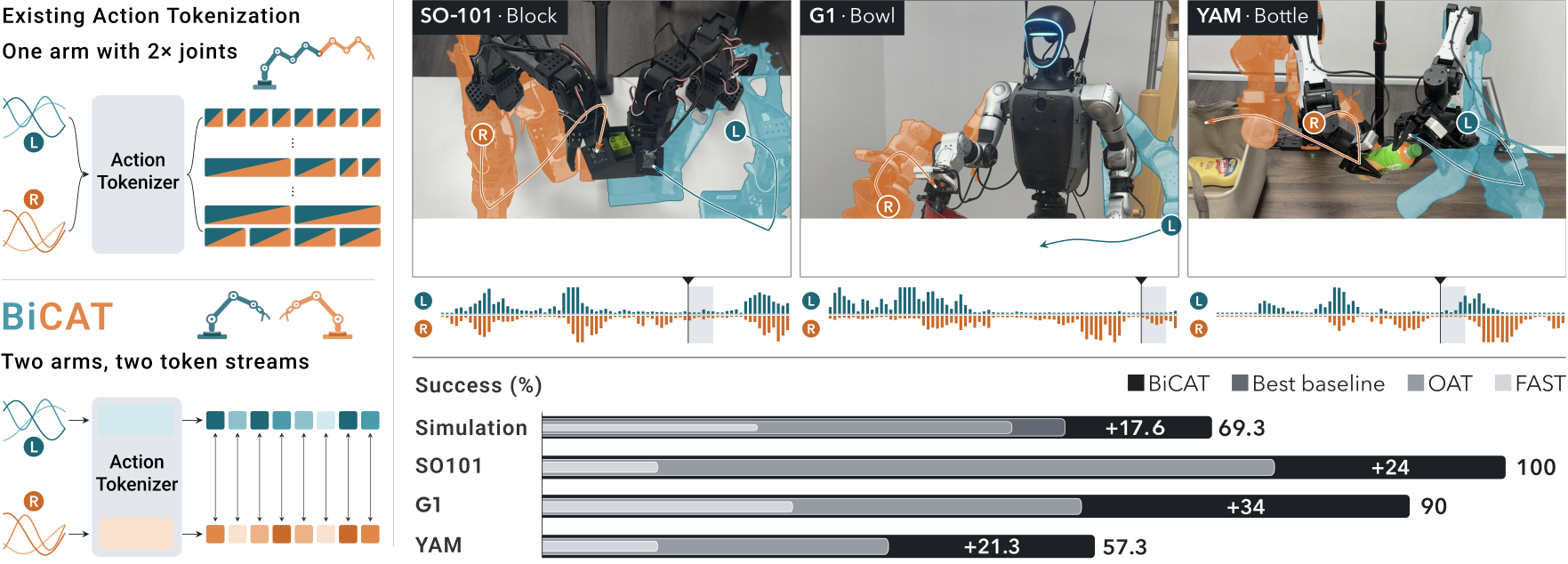
Left: existing tokenizers mix left and right arms in every token, while BiCAT gives each arm its own partner-aware token stream. Right: BiCAT rollouts on SO-101, G1 and YAM with per-arm motion over time, and success-rate gains in simulation and on real robots.

A bimanual robot is two arms, not one arm with twice the joints. Left: existing tokenizers treat the two arms as a single arm and mix the left and right arm in every token; BiCAT gives each arm its own token stream, aware of its partner. Right: BiCAT rollouts on three embodiments with each arm's motion over time, and success rates in simulation and on real robots; white numbers give the gain over the best baseline. PDF ↗

Abstract

The action tokenizer is a natural place to model how two arms coordinate.

Autoregressive vision-language-action (VLA) models predict discrete action tokens with the next-token objective of their vision-language backbone, so the action tokenizer defines the interface between the policy and the robot. In bimanual manipulation, the two arms share a repertoire of movements yet coordinate through complementary roles, and an action representation should capture both. However, most existing tokenizers encode both arms as a single concatenated action vector, in which motion patterns common to the two arms are not shared and cross-arm dependencies remain entangled within each token. The policy must therefore learn both aspects implicitly. We propose Bimanual Coordination Action Tokenization (BiCAT), which shares one motion representation across arms while conditioning each arm’s tokens on its partner through symmetric cross-arm attention and a joint decoder. The policy then predicts all tokens of each arm in parallel, generating the left arm first and the right arm conditioned on it. Across ten RoboTwin 2.0 tasks and six real-world tasks on three embodiments, BiCAT achieves the highest success among the compared tokenizers. In simulation, it improves mean success by 17.6 percentage points over the strongest of eight baselines, with the largest gains on tasks that require close coordination between the arms, while requiring only 40.5 ms per action chunk. These results suggest that the action tokenizer is a natural place to model bimanual coordination.

Insight

Keep the arms apart.
Let them talk.

A bimanual robot is two arms, not one arm with twice the joints. BiCAT gives each arm its own token stream, aware of its partner.

Joint tokenization

One vector, both arms

The chunk [AL ‖ AR] is tokenized as one action vector, so a token can mix both arms. Motion patterns common to the two arms are not shared, and cross-arm dependencies are left for the policy to learn implicitly.

Arm identityShared motion
Per-arm tokenization

Two streams, no partner

Each arm is tokenized separately, yr = T(Ar). Tokens are arm-indexed, but each arm's tokens are computed without its partner, discarding the context that coordinated motions depend on.

Arm identityPartner context
BiCAT

Two streams, partner-aware

(yL, yR) = T(AL, AR). One motion representation is shared across the mirrored arms, and each arm's tokens are conditioned on its partner through symmetric causal cross-attention and a joint decoder.

Arm identityPartner contextShared motion

Method

Tokenize together.
Predict in two blocks.

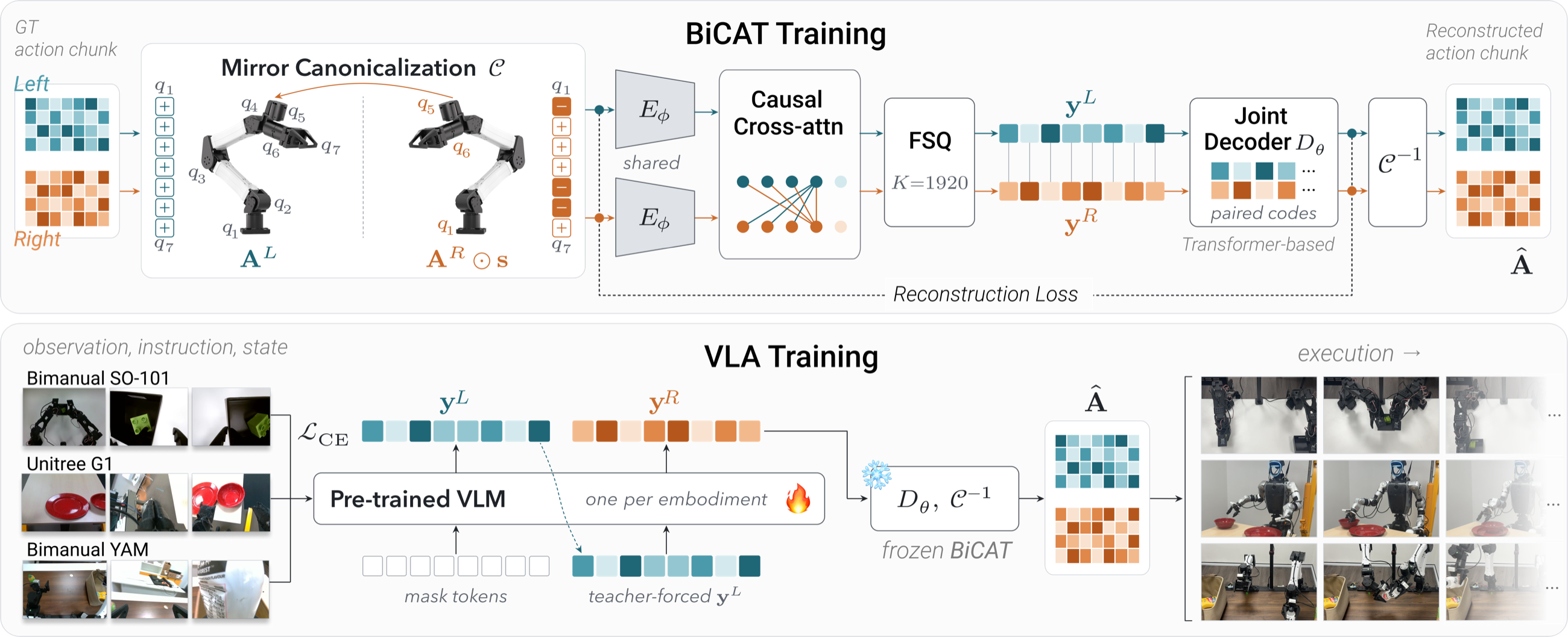
BiCAT overview. Top, tokenizer training: mirror canonicalization, shared encoder, causal cross-attention, FSQ with K=1920, joint decoder, reconstruction loss. Bottom, VLA training: a pre-trained VLM predicts left-arm tokens, then right-arm tokens; the frozen BiCAT decoder returns actions executed on SO-101, G1 and YAM.

Overview of BiCAT. Top: mirror canonicalization flips the signed joints of the right arm and applies shared normalization; the shared encoder and causal cross-attention give each arm its partner's context before FSQ; the joint decoder reconstructs the canonical chunk. Bottom: a VLM predicts yL, then yR; the frozen decoder returns actions. Teal: left arm; orange: right arm. PDF ↗

2

Partner-aware tokens

A shared causal encoder compresses each arm's 32-step chunk into 8 latents. Symmetric causal cross-attention adds partner context before FSQ (K = 1920), and a joint decoder reconstructs both arms from temporally paired codes.

3

Two-block prediction

The VLA predicts all 8 left-arm tokens in parallel, then all 8 right-arm tokens conditioned on them: two decoding steps and 40.5 ms per action chunk.

Real-world deployment

Same robot. Same scene.
Only the tokenizer changes.

Six tasks on SO-101, Unitree G1 and YAM, 25 trials each. All three policies share the data, backbone and training; only the action tokenizer differs.

Successful trials out of 25

Representative rollouts, started together. The robot waits while the policy predicts each chunk, so slower inference also lengthens the episode.

Overall success

Trials pooled across all six tasks and three embodiments

BiCAT leads on every task. Real-world policies use Molmo2-ER and execute all 32 steps of each chunk before replanning.

Inference latency

Observation to action chunk on Bimanual YAM, mean ± std (lower is better)

Measured over all inference calls during the YAM evaluation on one NVIDIA RTX 5090.

Simulation · RoboTwin 2.0

The tighter the coupling,
the larger the gain.

Nine tokenizers, one PaliGemma 2-3B policy recipe, ten tasks grouped by inter-arm coupling, 100 rollouts per task. BiCAT gains 1.5 points on single-arm tasks, 17.5 on loosely coupled and 21.3 on tightly coupled tasks over the strongest baseline in each group.

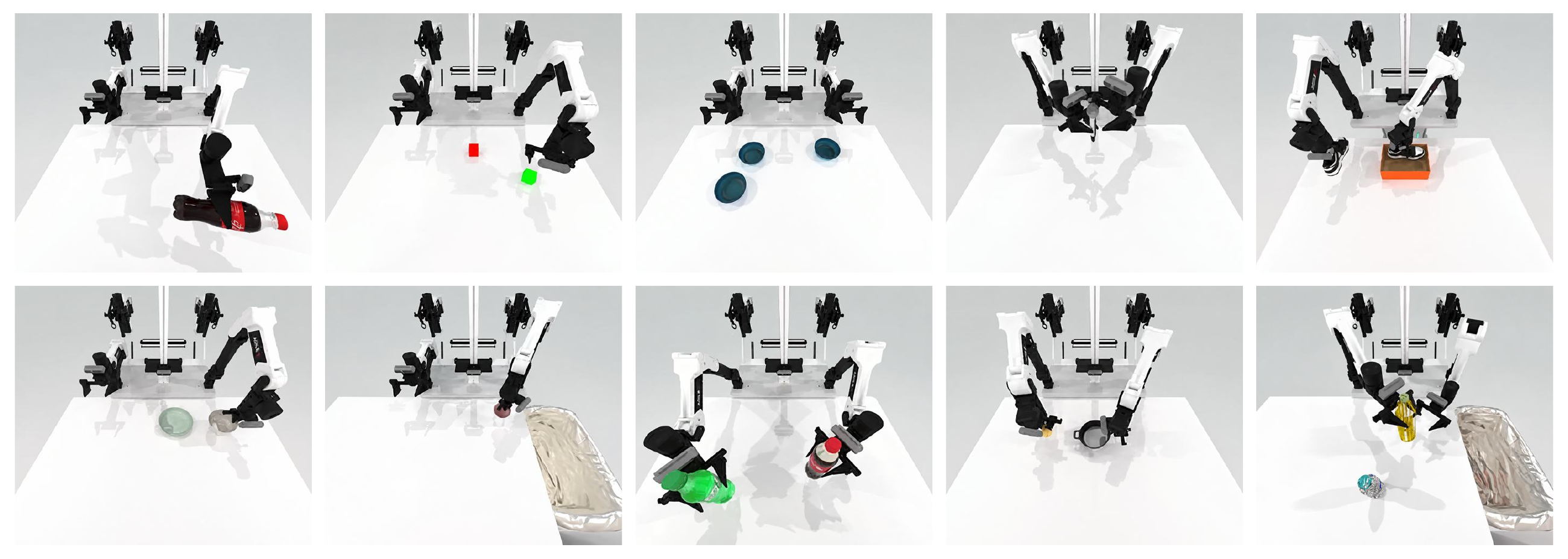
The ten RoboTwin 2.0 evaluation tasks, grouped into single-arm, loosely coupled and tightly coupled.

Mean success rate (%)

Unweighted average over all ten tasks

Label shows each tokenizer's mean; for BiCAT, the gain over the strongest baseline in the selected group. All methods share data, backbone, observations and optimization, and differ only in the tokenizer and its prediction schedule.

Per-task success table

Success vs. decoding time

Policy token-generation time per chunk on one H200 (log scale)

BiCAT matches two-block tokenizers in speed and is 5.6× to over 11× faster than tokenizers decoded token by token. Only single-block ActionCodec is faster, but predicting BiCAT's tokens in one block costs 18.2 points.

Every component matters

Ablations, mean success (%) on the ten tasks

Cross-arm attention and joint decoding are complementary: each adds far more when the other is present. Neither partner-aware codes without the arm-wise schedule nor the schedule without them exceeds NAC (51.7).

Analysis

Reconstruction isn't the goal.
Closed-loop control is.

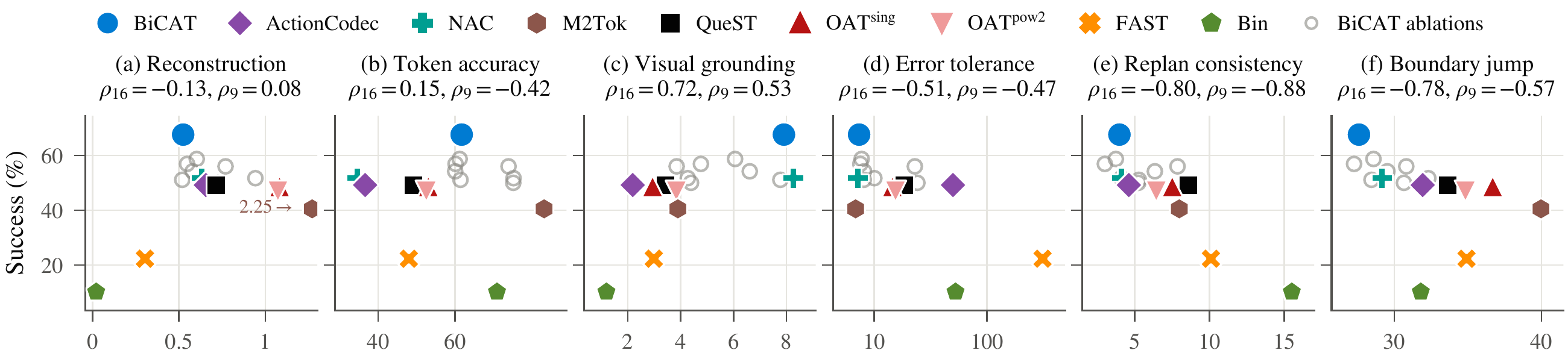
Reconstruction error does not predict success (ρ = −0.13): Bin and FAST reconstruct best yet perform worst. Success instead tracks reliance on vision (ρ = 0.72), consistency across replanning (ρ = −0.80) and smoothness at chunk boundaries (ρ = −0.78), where BiCAT has the smallest jump of the nine tokenizers.

Six scatter plots of mean RoboTwin success against reconstruction MSE, token accuracy, visual grounding, error tolerance, replanning consistency and boundary jump, for nine tokenizers and seven BiCAT ablations.

What tracks closed-loop success. Filled markers: nine tokenizers; hollow grey markers: seven BiCAT ablations. Spearman correlations over all 16 points (ρ16) and over the nine tokenizers (ρ9). As eight of the 16 points are BiCAT or its variants, the correlations are descriptive rather than causal. PDF ↗

Citation

BibTeX

@article{liu2026bicat,
  title   = {BiCAT: Bimanual Coordination Action Tokenization},
  author  = {Liu, Xuanwei and Cao, Guipu and Luo, Zhongyi and Duan, Jiafei},
  journal = {arXiv preprint arXiv:2611.23499},
  year    = {2026}
}